
Starlink
or 4G & 5G?
If fibre has not reached you, there are two good ways to get fast broadband without a phone line: mobile broadband over 4G or 5G, and Starlink satellite. Which one suits you depends on where you are, not on which has the better advert.
Updated November 2026 · All guides
How Each
One Works
4G and 5G broadband uses the same mobile networks as your phone. A router with a SIM card, usually with an antenna fitted outside, picks up the signal from the nearest mast and turns it into broadband for the building.
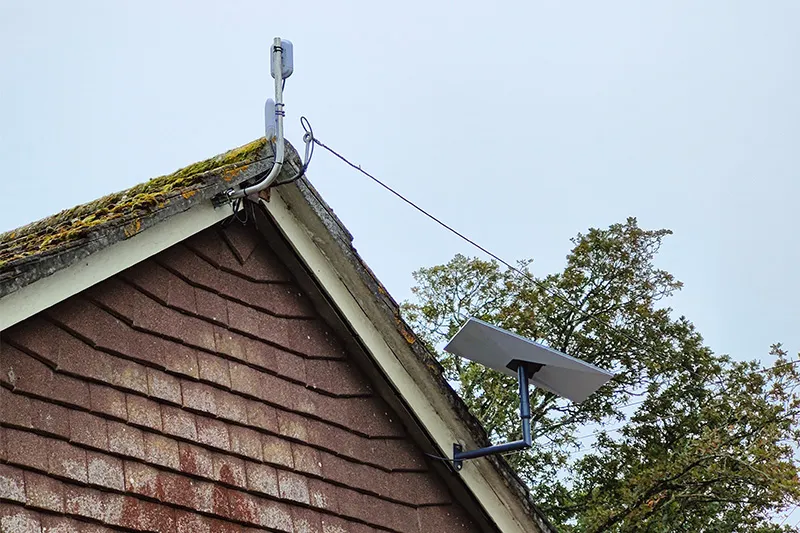
Starlink uses a dish that talks to satellites passing overhead. It does not need a mast or a phone line nearby. It needs power and a clear view of the sky.
If full fibre is available at your address, that is usually the best choice, so check that first.
When 4G or 5G
Is the Better Choice
- A survey shows a strong signal from at least one network.
- An outside antenna can be pointed at a mast.
- Trees or buildings block too much of the sky for a dish.
- You want a simple, compact installation.
The antenna matters more than most people expect. A router on a windowsill and the same router with a properly aimed outside antenna can perform very differently.
Watch Out For
- Signal that is fine in winter and poor in August, when visitors fill the network
- Data limits on some mobile plans
- Coverage maps: they show what should happen, not what does
When Starlink
Is the Better Choice
- There is little or no mobile signal, even with an outside antenna.
- The local mobile network slows down badly at busy times.
- You have a clear, open view of the sky.
- The site is remote, temporary or moves, such as a vehicle or a boat.
Where the dish goes decides how well it works. Even a small obstruction can cause short dropouts, so it is worth mounting it properly.
For Business
- Starlink can be built into your network with your own firewall, WiFi, phones and CCTV
- We can provide a fixed IP address on business connections when we integrate it
- We monitor every Starlink business connection we look after, 24 hours a day
Why Not
Both?
For a business, the safest answer is often both. Starlink and mobile broadband fail for different reasons, so they rarely fail together.
- Backup. One connection does the work and the other takes over on its own if it drops.
- Bonding. Both are combined into one connection, so losing one does not interrupt you. It is how we keep buses and coaches online.
Help With the Cost
- In Wales, a grant of up to £800 may be available towards a faster connection
- It can cover mobile broadband and satellite
- We check whether you qualify for free
Want a straight answer for your address? Call 01437 76 33 33 (Wales) or 01579 68 60 01 (South West).
More Guides
The 2027 Phone Line Switch Off
What is being switched off, what it affects in your business and what to do before 31 January 2027.
Read the guideChoosing a Holiday Park WiFi Provider
Ten questions to ask before you sign, and the answers you should expect.
Read the guidePrivate 5G Explained
What a private 5G network is, what it needs and who it is for.
Read the guide
Not Sure
Which Is Right?
Tell us where you are. We’ll check what is available, survey the signal if it is worth doing and give you an honest recommendation.
Alternatively, you can contact us on:
You’ll be answered by a human in our office!
Starlink or 4G & 5G
Frequently Asked Questions
Is Starlink better than 4G or 5G broadband?
Neither is better everywhere. Mobile broadband is usually the right choice where a survey shows a strong signal. Starlink is usually right where there is little or no signal and a clear view of the sky.
Do I need an outside antenna for 4G or 5G broadband?
In rural areas, usually yes. An antenna fitted outside and aimed at the mast often makes the difference between a poor connection and a good one.
Does bad weather affect Starlink?
Very heavy rain or snow can cause brief interruptions. For a business that cannot be offline, a mobile backup connection covers those moments.
Can I use Starlink and 4G together?
Yes. They can be set up so one takes over if the other fails, or bonded into a single connection. We do both.